Cameras 📹 Camera tour is .

Outside is 31.64 °F with 82% RH. Updated: 10:10 PM.


Current conditions via 1-Wire sensor network

Pumps and Water Levels

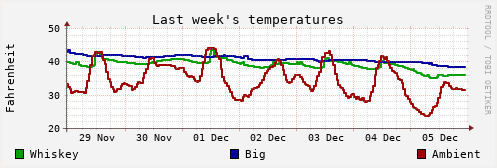
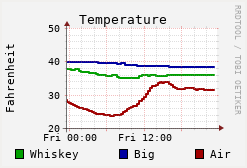
Temperatures via 1-Wire sensor network


Incubator via 1-Wire sensor network


Weather via Weather Underground

I operate a weather station in the backyard known as KNJGLOUC4 to Weather Underground. Here are the latest conditions.

Overview

Water without animals is just used for breeding mosquitoes. I keep everything in the pond native (with the exception of the water lettuce and hyacinth). Animals include eastern painted turtles, stinkpots, blue gill sunfish, pumpkin seed sunfish, fathead minnows, shiners, crawfish, bullfrogs, common toads, green frogs, catfish, snails, clams, etc. No koi!

Some of my previous pets have really inspired me to keep building and to put up with the sometimes endless issues that can arise. Bernadette turtle is at the top of the list and she has a memorial stone inside the fenced area dedicating the area "Bernadette's Pond". Lucky also spurred me on to create "Lucky's Lodge", a place for wayward and injured turtles to be.

History

I grew up on the ponds and lakes of South Jersey. From middle school onward, I spent most of my time on the ponds along Valleybrook golf course (before people lost their minds and overbuilt it with townhouses). I then migrated to the ponds back behind Broadmoor West, particularly "turtle cove". It was just a sandy beach, away from people, where the turtles would be. I'd fish. Sit. Think. It was around that time that I promised myself that when I could, I'd have that kind of peace in my yard.

Fast forward to 2009, the "year of the house". I finally had my own house and way too much work to do on it. But, brewing in the background, were pond plans. Actually, that's when I bought the first webcams; 3 years before I used them. I knew I'd want them.

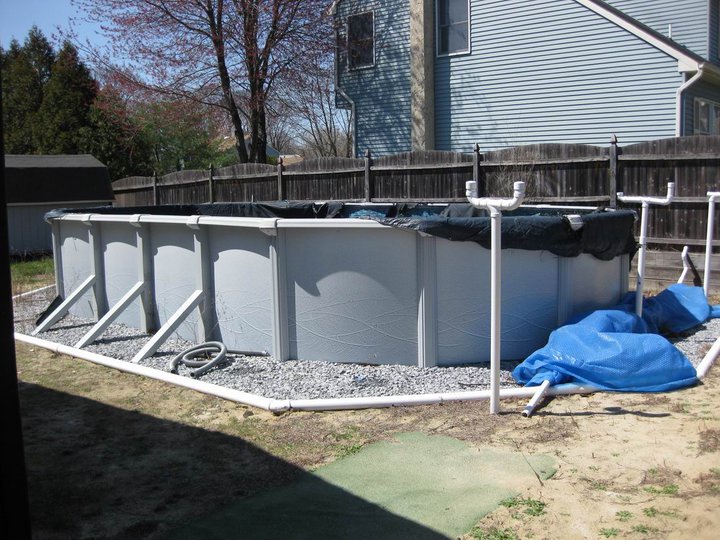
The backyard started as an above ground pool. It had not been opened in awhile, the cover had torn and nature had taken over. I even had ducks living on it. After some irritation with Craigslist, I eventually sold it and was left with a sandy, weed infested space.

The first ponds went in the Spring of 2010. I had some ideas as to what would work (and some of it was even right). I had constant problems with leaks, ponds draining, filter boxes melting and all sorts of things. That winter was even more brutal with freeze ups leading to overflows. Somehow I made it to 2011. Well, as any pond person will tell you, they're addictive. I added 100% more water that spring.

In spring 2012 I reconfigured again. This time I added at least 100% more water again (in the same space, with the same pumps). The 1-wire sensor network was also installed.

In 2013 I added the center rear pond and installed the matrix video switcher, upgrading the number of available cameras to 8.

In 2014, I installed Milone eTape liquid level sensors. They worked well for the season but ultimately I found them to be too fragile for an outdoor environment. I also put X10 controllers on the pumps so I can control them remotely.

In 2015 I added additional 1wire thermometers (to the deep pond, rear center and alligator pond). A new weather station was installed to get more accurate weather data. I also had my first eggs! I dumped the X10 for a dedicated power controller, an IP Power 9258. Hopefully it's more reliable (it's not and I went back to X10). I also built the box turtle commune. I'm hoping to have a breeding colony of box turtles in 2016. Season start 4/5. Season end first week of October.

In 2016 the season started late at 5/8 for the big guys and 5/28 (!!) for the small guys. The DS2438s started acting a little weird so I swapped them out for DS2406s. The float sensors didn't utilize the DS2438 very well anyway. I swapped out the Beagle Bone Black with a Samsung ChromeBox XE300M22. It uses about the same amount of watts but after flashing the Chromebox to run CentOS 6.8, I can do many more things (namely running ffmpeg natively and mounting iSCSI LUNs).

In 2017, I retired the Axis 241q and AutoPatch Half-Y and replaced them with an Axis m7016. It took over a month in the mail to receive, but it was worth it.

In 2018, I didn't change much up. An intense thunderstorm overloaded my 1-wire bus master controller in September. I didn't get any hatchlings -- the loss of Baby P left me without an adult male for the season. Season started 1st week of May and ended Oct 7. I upgraded from the Chromebox to an Intel NUC DC3217IYE -- faster CPU and more SSD.

In 2019, the season started for the boxies and spotteds on 4/6. 5 adult and 10 youngin' painteds went out on 4/19. Doc was picked up from Lititz, PA on 4/26. The season ended on 10/12 due to forecasted weather.

In 2020, the season started for all the turtles on 4/6. The ObserverIP was replaced with an Ecowitt GW1000 and the WS1400-IP weather station with a WS-2902-Array. The painteds came in 10/3.

In 2021, I was really craving the spring due to a snowy winter and pandemic. I pulled electric from the house to the shed underneath a newly created box and spotted turtle house. It was a massive build but ultimately the enclosure went from 4'x4' to 4'x12' (50% larger for boxies; 115% larger for spotteds). The big creatures (boxies, spotteds and adult painteds) went out around 4/4. Raccoon issues spurred me to install an electric fence in early August.

In 2022, the main air pump and big pond pump were replaced. The season for the big guys started mid-April and the babies mid-May. I picked up a quartet of stinkpots. I switched over the 1-wire therms to a Konnected alarm board. That allows me to drastically shorten the length of the 1-wire network and reduce interference.

In 2023, I swapped (and rebuilt) the main air pump. All turtles went out the week of 4/16. I picked up Brooke and Banks (stinkpots) and built a stinkpot enclosure. I also built Dora her own enclosure. I picked up Michaelangelo on 11/5. I virtualized the computer that reads the sensors to a Proxmox LXC for resiliency.

In 2024 I developed holes in both of my flexible ponds... I replaced the "deep" pond with a hard shell and just relined the other. The electric fence was restrung since it was drooping. Most critters went out on 4/9. I added a camera on the stinkpot hut.

In 2025 the critters went out on 4/19.

Painted turtles (eastern)


Chrysemys picta picta

Painteds have been a favorite turtle of mine since the 6th grade. That's when I got Pete (who was my companion for approximately 25 years). They're fun to watch and each one has their own personality. It's amazing how they range from being totally docile to... extremely "feisty".

Current Painteds

Egg Clutches

In Memoriam

Baby stinkpot 22g; 36g; 47.9g; 76.2g; 97g; 122.9g; 196g
Baby stinkpots: 17g

Box turtles (eastern)


Terrapene carolina carolina

My box turtles are all rescues (i.e.. they were posted on Craigslist for adoption and I took them in). None of them were removed from nature by me.

They live in an outdoor enclosure (outside view / inside view) I built. It was originally 18 sq feet but I enlarged it to 24 sq ft in 2021. The enclosure has about 18" of depth, with the bottom being lined with paving stones so that the turtles can dig but not escape. The walls are made of wavy plastic (the kind used for greenhouse roofs). It's doubly reinforced -- the panels are screwed in to the frame and then the edges of the panels are concealed on the inside. The hinged lid is covered in plastic-coated chain link fence to keep out predators. It has native plantings of strawberry and also includes geranium, a small hosta and stonecrop. I have integrated the enclosure with my irrigation system -- the soaking pond and plants get watered automatically. A mister will also spray down the enclosure. The hide box in the corner is a basic frame covered with pine tree bark for aesthetics.

It's loaded with leaves right now to add natural nutrients and attract bugs. Some of the leaves will be taken out in the spring.

Current Boxies

NameHatchedAddedLocalityGender2015201620172018201920202021202220232024
Rex2005 (?)2015PA → NJM 622.6g; Pic 590.7g; Pic 580.2g; Pic 600.3g; Pic 566.2g; Pic 686.0g; Pic 614.0g; Pic 638.0g; Pic 644.0g; Pic 642.0g; Pic
Grumpy2010 (?)2013SC → NJM 169.7g; Pic 194.2g; Pic 205.6g; Pic 234.7g; Pic 233.8g; Pic 285.4g; Pic 304g; Pic 342g; Pic 399g; Pic 407g; Pic
Laverne2005 (?)2015NC → TN → NJF 416g; Pic 418.2g; Pic 400.4g; Pic 374.2g; Pic
Shirley2005 (?)2015NC → TN → NJF 524g; Pic 504.7g; Pic 493.4g; Pic 479.4g; Pic 467.2g; Pic 529.6g; Pic 517g; Pic 527g; Pic 543g; Pic 553g; Pic
Lucy20192020MO → NJ? 25.3g; Pic 54g; Pic 96.6g; Pic 137g; Pic 204g; Pic
Dottie20192020MO → NJ? 22.1g; Pic 38g; Pic 64g; Pic 85g; Pic 118g; Pic
Clementine20192020MO → NJ? 17.9g; Pic 33g; Pic 65g; Pic 92g; Pic 135g; Pic
Doris2005 (?)2021NJ → NJF 502g; Pic 558g; Pic 500g; Pic 553g; Pic
Thistlehaire200222022CB? 11.8g; Pic
Dora?2022CBF 447g; Pic 441g; Pic

Egg Clutches

Hopefully I will have a breeding colony this spring. I plan to incubate at 80°F.

ClutchDrop DateEggsDispositionIncubationHatch DateMotherHatchlings
16/24/20222std8/23Shirley
16/26/20244std8/18Shirley
16/19/20255std8/10Juliette
26/25/20254std8/23Shirley
37/12/20250std8/23Doris
47/13/20254std9/12Shirley
57/13/20254std9/12Juliette

Spotted turtles


Clemmys guttata

I've been fascinated with spotteds for awhile... they're so very different and unique from any other turtles out there. All of my current animals are, again, either captive bred or CraigsList rescues -- not natively collected.

Current Spotteds

Egg Clutches


Musk turtles


Sternotherus odoratus

Musk turtles (more commonly called stinkpots) are another favorite of mine. They stay relatively small, are somewhat intelligent and fun to watch walking along the bottom.

I have 7 stinkpots presently. The oldest is "Baby", followed by Brooke and Banks and then 4 siblings.
NameBirth YearAdded YearLocalityGender202220232024
Baby~20102010CB-P/?M196g 188g; Pic 184g; Pic
Brooke~20212023CB-P/?F 102g; Pic 124g; Pic
Banks~20212023CB-P/?M 67g; Pic 91g; Pic
Quartet 1~20222022CB-P/??17g33g32g
Quartet 2~20222022CB-P/???
Quartet 3~20222022CB-P/???
Quartet 4~20222022CB-P/???

Outside Setup

There are 3 exterior-grade CAT5 data lines (cable1, cable2 and cable3) going out to the pond area. They're primarily responsible for pondcam video, camera power and sensor networking. Three flat CAT5s (cable4, cable5 and cable6) complete the wiring.

Cable1 terminates in a Keptel weather-proof enclosure in the middle of pond land. Cable1 has 4 passive BNC baluns (each balun uses 1 pair of the cable) and provides video for the "Big Pond", "Deep Pond", "Alligator Pond" and "Rear Center Pond" feeds. Power is supplied to the 4 cameras by a power adapter hidden under a fake rock. Cable1 is completely provisioned.

Cable2 terminates between the "Whiskey Barrel" and "Deep Pond". It currently only has 2 pairs in use; one providing the "Whiskey Barrel" feed and the other for camera power. It has two unprovisioned pairs.

Cable3 terminates in a Keptel weather-proof enclosure behind the whiskey barrel and serves as my 1-wire sensor feed. The blue pair runs 1-wire data and the brown pair is +12vdc.

Cable4 goes out my cellar window to provide the "Lucky's Lodge" feed. 2 pairs of this cable are in use; one for video and one for camera power. It's not usually patched in.

Cable5 goes out another cellar window to provide the "Box Turtle" feed. 2 pairs of this cable are in use; one for video and one for camera power.

Cable6 goes out the same cellar window to provide the "Stinkpot" feed.

Power for cable2 and the cable4 are provided via a power connector in the wiring closet.

Behind the Whiskey Barrel is a Keptel TA-100 enclosure that houses a Konnected alarm board. The board reads pond temps using 1-wire therms and also checks the water levels using float sensors.

Inside Setup

The technical nerve center of the ponds is Swordfish (SF), a flashed Samsung Chromebox machine. It's a low power Linux machine. Its main duty is reading sensors and controlling devices via serial connections. A GearMo quad port FTDI serial port controller is attached to SF to provide serial ports.

Inside, the CAT5 cables are terminated on a patch panel. Baluns are attached to patch cables and attached to an Axis m7016 video server. This web server proxies requests to the m7016.

The temperature graphs are available via the 1-Wire sensor network. A DS9490r USB 1-wire bus master is attached to SF. A custom cable was made to connect the 6P6C port on the DS9490r to a standard 8P8C (RJ45) connector using the 568a standard. The RJ45 connector is plugged in to an OpenHouse H619 12-port, bridged module. The upshot is that I can have 1-wire devices anywhere my patch panel reaches and only need to patch them in. The sensors are read periodically using owfs/crontab and the results are sent via the web to this machine. RRDtool is used to store the data and generate graphs.

The pumps are controlled via Heyu, based on whether or not the float switches are in a good position. If SF detects low water conditions, it will send a signal to the appropriate X10 module to shutoff to avert more water loss.

The timelapse videos are created on SF and stored on an iSCSI LUN on my SAN. To save wear and tear on disk (and since SF has more memory than I need), images are stored on a RAM disk. At the end of the series, ffmpeg is used to convert the images to a time-lapsed video. Since switching to SF, I was able to retire a USB hub and a SFF Dell machine (that previously did the video stuff).

Other critters

Bearded Dragons
NameBirth YearGender20202021202220232024
Ricky2019M448504477494504
Eddie2019F424446481584577
Pebbles2023F316433

ClutchDrop DateEggs
13/25/202213
24/23/202222
35/21/202219
46/15/202219


Pancakes
7/8 : found 3 eggs
7/17 : 2 eggs (1 smashed)
7/19: 1 egg

2022-
Biggie Girl: 1127, Jamie: 512, Girl (no dot): 535, Dot girl, 559

2023-
Biggie Girl: 1179, Jamie: 530, Girl (no dot): 576, Dot girl, 607